


Is Bipolar Ionisation Safe? Glass DBD Technology and UL 2998 Explained | ProMedUSA Singapore
Learn more….Is bipolar ionisation safe? ProMedUSA has 20 years of IAQ experience and 8 years of certified Glass DBD bipolar ionisation deployments across Singapore. Here is what the technology, the science, and the independent certification actually show.
There’s a narrative gaining traction online: that all ionisers, plasma devices, and bipolar ionisation systems are unsafe for occupied spaces.
ProMedUSA has been Singapore’s trusted indoor air quality provider since 2006 — UV ozone generators from the start, air purification solutions from 2010, and certified PurAire Glass DBD bipolar ionisation added in 2017. Eight years of measured bipolar ionisation deployments across hotels, hospitals, clinics, and commercial facilities.
We’ve seen what works and what doesn’t. We measure outcomes with calibrated instruments. And we think the current narrative around bipolar ionisation safety is missing the most important distinction: it’s not one technology.
Certified Glass DBD Cold Plasma bipolar ionisation is safe for continuous 24/7 use in occupied spaces. The physics of the design, 263 peer-reviewed studies, and independent UL 2998 certification all confirm it.
The Most Important Distinction Nobody’s Making
When an article warns that ‘bipolar ionisation may produce ozone,’ it may be making an accurate statement about certain ionisation designs.
But it becomes dangerously misleading when applied to all bipolar ionisation systems regardless of technology or certification.
The technology behind the device determines whether ozone is produced. And the independent certification determines whether you can trust the manufacturer’s claim about it.
Not All Bipolar Ionisation Is the Same — Why the Technology Design Matters
This is where most articles miss the point entirely. ‘Bipolar ionisation’ is not a single technology. It’s a category — and the design underneath it makes all the difference.
How Glass DBD Cold Plasma Works
DBD stands for Dielectric Barrier Discharge. In PurAire’s Glass DBD systems, an alternating current (AC) voltage is applied across two electrodes separated by a glass dielectric barrier. That barrier acts like a capacitor — it caps the current and prevents harsh electrical arcs. Instead, it creates millions of evenly distributed micro-discharges across the surface.
As the AC cycle alternates between positive and negative voltages, air molecules passing through the plasma field simultaneously gain and lose electrons — producing a naturally balanced 1:1 ratio of positive and negative oxygen ions. No engineering tricks required. It’s inherent to the physics of how DBD works.
Because the discharge is distributed evenly — not concentrated at a single point — there are no localised high-energy hotspots.
That’s the reason Glass DBD produces virtually no ozone. The thermal conditions that would split O2 molecules into atomic oxygen simply don’t occur.
How Corona Discharge Ionisation Works — and Why It’s Different
Corona discharge uses a high-voltage current applied to a sharp conductive tip — a needle, carbon fibre emitter, or tungsten point. The concentrated electrical field around that tip creates a localised plasma plume.
Here’s the critical problem: if the system uses direct current (DC), it produces only one polarity of ions — positive or negative, not both. That’s not true bipolar ionisation at all. To produce genuine bipolar output from corona discharge, manufacturers must either use AC on a single needle or pair separate positive and negative needle arrays — a specific engineering choice that many cheaper units simply don’t make.
More importantly, the intense localised energy at a corona needle tip creates the high-temperature conditions that split O2 molecules — generating ozone as a byproduct. As needle tips age, oxidise, and accumulate deposits, voltage regulation becomes inconsistent and ozone output can spike unpredictably.
Glass DBD is inherently bipolar, inherently low-ozone, and inherently stable. Corona discharge can be engineered to approach that standard — but it requires specific design choices, and many commercial units don’t make them. UL 2998 certification is the independent proof of which category a product actually falls into.
The Independent “Gold” Standard: UL 2998
UL 2998 exists precisely because not all ionisation devices perform as marketed. It’s independent third-party testing by Underwriters Laboratories — a device must emit less than 0.005 ppm of ozone under real-world operating conditions to earn certification.
- Ten times stricter than the older UL 867 standard (0.050 ppm)
- Ten times stricter than the US FDA limit for medical devices (0.050 ppm)
- Below quantifiable detection levels for standard ozone testing
- Product-specific — each individual model tested independently, not the brand
The US EPA states clearly: if you choose bipolar ionisation, choose a device certified to UL 2998. PurAire’s fixed, wall-mounted, and in-duct Glass DBD range meets that standard on every model.
The EPA doesn’t say avoid bipolar ionisation.
It says choose UL 2998 certified products.
That’s the distinction the safety narrative online consistently misses.
What 263 Peer-Reviewed Studies Show
The Jiang et al. review examined 263 peer-reviewed research papers on bipolar ionisation. No evidence of harm to humans. Published studies additionally show negative ions actively benefit memory, cognition, and alertness.
Certified bipolar ionisation also:
- Neutralises airborne bacteria, viruses, mould spores, and allergens
- Breaks down VOCs from furniture, adhesives, carpets, and building materials
- Agglomerates fine particles so they fall out of the breathing zone
- Reduces surface contamination — not just airborne pollutants
Peer-reviewed research found no evidence air ionisation harms humans. Published studies show negative ions actively benefit human memory, cognition, and alertness. Our certified products produce only ions — not ozone, not byproducts.
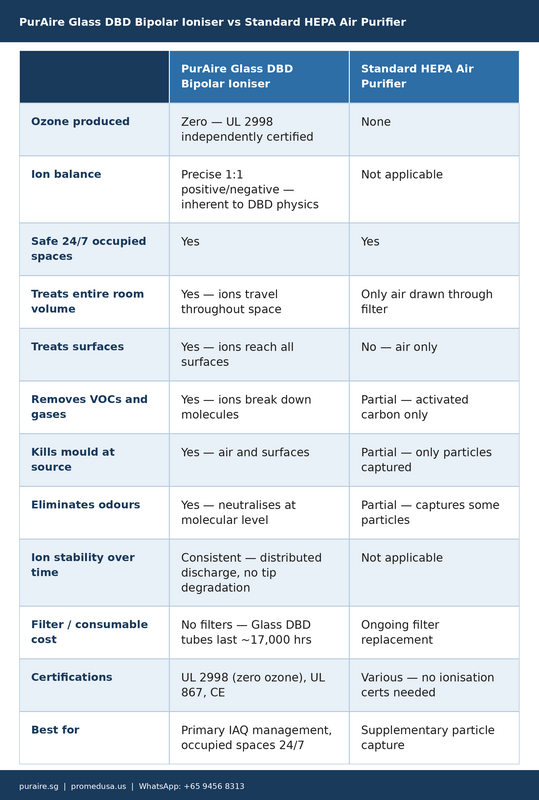
PurAire Glass DBD vs Standard HEPA Air Purifier
ProMedUSA’s IAQ Evolution — 20 Years, Three Technologies
ProMedUSA has been Singapore’s trusted IAQ provider since 2006. That history breaks down clearly:
- 2006 — Professional UV ozone generators for deep odour removal and surface disinfection in unoccupied commercial spaces
- 2010 — Expanded into air purification solutions for occupied spaces
- 2017 — Added certified PurAire Glass DBD bipolar ionisation after the technology and UL 2998 independent certification met our standards for recommendation
Eight years of bipolar ionisation deployments. Twenty years of IAQ expertise. We added bipolar ionisation to our portfolio because the science was solid, the certification was independent, and the results were measurable — not because it was fashionable.
Transparency: The Full ProMedUSA Technology Picture
ProMedUSA covers three complementary IAQ technologies. Each is chosen for a specific application — and we’re straight about what each does.
- PurAire fixed, wall-mounted, and in-duct Glass DBD bipolar ionisers — UL 2998 and UL 867 certified. Continuous 24/7 operation in occupied spaces. Hotels, hospitals, clinics, offices, commercial facilities.
- PurAire AirPro-MAX and PurAire DUO portable units — not UL 2998 certified. Produce a very, very small amount of ozone at the output nozzle. In normal room conditions with air circulation, the ozone quickly disperses to virtually unmeasurable levels (as tested by TUV). Used daily by housekeepers across Singapore and Southeast Asia for rapid room freshening.
- ProMedUSA UV ozone generators — deliberately produce ozone for deep treatment of unoccupied spaces: bin centres, vacant hotel rooms, garbage rooms, vehicles. Powerful, proven, and used correctly with vacated spaces and natural ozone dissipation before re-entry.
The right technology for the right application. That’s how ProMedUSA has built trust with more than 45 organisations across Singapore.
Frequently Asked Questions
Q. Is bipolar ionisation safe for occupied spaces in Singapore?
Yes — when using Glass DBD technology certified to UL 2998. PurAire’s fixed, wall-mounted, and in-duct Glass DBD range is independently verified to emit less than 0.005 ppm of ozone under real-world conditions (UL2998). These systems have been running continuously in Singapore commercial spaces since 2017
Q. What is the difference between Glass DBD and corona discharge ionisation?
Glass DBD uses an AC voltage across a glass dielectric barrier to create evenly distributed micro-discharges, producing inherently balanced 1:1 bipolar ions with virtually no ozone. Corona discharge concentrates high-voltage energy at a needle tip — creating ozone-generating conditions and often producing only single-polarity ions. Glass DBD is more stable, more consistently bipolar, and inherently safer by design.
Q. Does PurAire’s bipolar ionisation produce ozone?
Some ionisation designs do — particularly those using corona discharge needle tips where localised high energy can split O2 molecules.
PurAire Glass DBD Cold Plasma is a fundamentally different design. The distributed discharge across the dielectric surface prevents those conditions.
UL 2998 certification independently verifies the result: less than 0.005 ppm — effectively zero.
Q. What does the EPA say about bipolar ionisation?
The US EPA states: if you choose bipolar ionisation technology, use a device that meets UL 2998 standard certification.
PurAire’s fixed range is certified to UL 2998 on every individual model — not the brand as a whole, but each specific product.
Q. How long has ProMedUSA been deploying bipolar ionisation in Singapore?
Since 2017 — eight years of certified Glass DBD bipolar ionisation deployments across hotels, hospitals, clinics, and commercial facilities. ProMedUSA’s broader IAQ history spans 20 years: UV ozone generators from 2006, air purification from 2010, and bipolar ionisation added in 2017 when the technology and independent certification met our standards for recommendation.
The Bottom Line
Certified Glass DBD bipolar ionisation is safe. Not because we say so — because the physics of the design says so, independent certification confirms it, and 263 peer-reviewed studies agree.
Choose technology that’s been independently verified. Demand UL 2998 certification. Ask what type of ionisation design is underneath the marketing. Those are the questions that separate genuinely safe, effective products from those that merely claim to be.
Talk to us about the right IAQ solution for your property.