


The Bin Centre Odour Problem: Why Singapore’s Climate Makes It Worse Than Anywhere Else
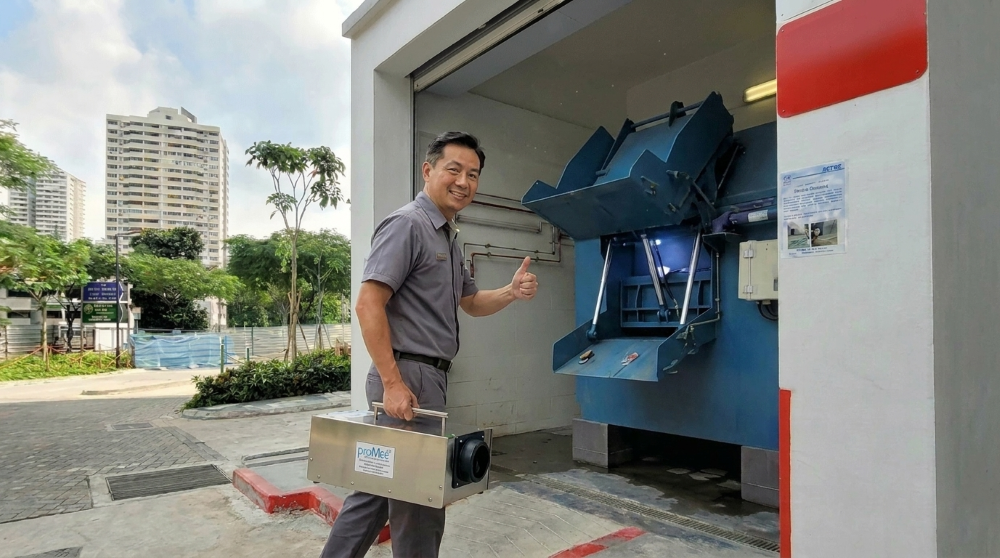
Every hotel, shopping mall, serviced apartment, integrated development, and commercial building in Singapore has a bin centre, compactor room, digester room, or grease trap room. In most countries, these spaces are unpleasant but manageable. In Singapore, they are a serious operational problem.
Singapore’s year-round heat — averaging 31 to 33 degrees Celsius — combined with humidity consistently above 80% creates conditions where organic waste begins generating hydrogen sulphide, ammonia, methane, and volatile organic compounds (VOCs) within hours of disposal. Hydrogen sulphide is the gas responsible for the characteristic rotten-egg smell of bin centres. Ammonia and VOCs add layers of sharp, acrid odour. Together, they make Singapore bin centres among the most hostile odour environments in any commercial setting.
The real danger is not just the smell in the bin centre itself. These gases are heavier than air, and they migrate. Through service corridors. Through HVAC negative-pressure returns. Through refuse chute chambers. They find their way to lift lobbies, back-of-house corridors, guest room floors, and food court areas. For a five-star Orchard Road hotel, one verified guest complaint about garbage smells reaching a room can cost a TripAdvisor rating point that takes months to recover. For a Jurong or Tampines shopping mall, persistent bin centre odour near a service entrance drives food court footfall down measurably.
NEA’s Code of Practice on Environmental Health (2024 Edition) requires all commercial developments exceeding 1,000 litres per day of refuse output to provide a dedicated bin centre. That is almost every hotel, mall, and mixed-use development in Singapore. Managing the odour from that bin centre is the facility manager’s responsibility — and it is a daily challenge.
Why Bin Centre Odour Control Solutions in Singapore Usually Fail
Facility managers across Singapore have tried every available product. Most work temporarily, if at all. Here is why the most common approaches fall short:
Masking Sprays and Aerosol Systems
Chemical masking sprays add a fragrance layer over the odour. In a warm, humid Singapore bin centre, that fragrance dissipates within one to two hours. The bacteria and VOCs producing the odour remain completely untouched. Cleaning staff working in these spaces report the combination of rotting waste and fading artificial fragrance is often worse than the original odour alone.
Bio-Enzyme Treatments
Bio-enzyme products introduce bacteria or enzymes that slowly break down organic matter over time. Applied consistently for several weeks, they can reduce baseline odour levels. However, they cannot address an acute odour event — a compactor breakdown over a public holiday weekend, or a heat spike accelerating decomposition — and they require ongoing, costly reapplication indefinitely.
Exhaust Ventilation Upgrades
Increasing exhaust ventilation from a bin centre moves air faster, but it does not treat the odour compounds in that air. Depending on the building’s HVAC configuration, stronger exhaust can actually increase negative pressure and draw bin centre air more efficiently into adjacent service corridors and lift lobbies. You distribute the problem more effectively — you do not solve it.
The fundamental issue is that none of these approaches destroys the molecules that cause the smell. They mask, dilute, relocate, or slowly degrade them. Only ozone — applied at the right concentration, in the right space, for the right duration — breaks odour compounds apart at a molecular level and leaves nothing behind.
How Ozone Permanently Eliminates Bin Centre Odours — The Science Explained Simply
Ozone (O₃) is a naturally occurring molecule. It is what you smell in clean outdoor air after a thunderstorm — that sharp, fresh scent is ozone produced by lightning breaking apart oxygen molecules. It is one of nature’s most powerful oxidising agents.
When ozone contacts an odour-causing compound — hydrogen sulphide, ammonia, any VOC — it breaks the chemical bonds that create the smell. The reaction is direct and immediate. The odour molecule is destroyed, not masked. The byproducts of the reaction are water vapour, carbon dioxide, and ordinary oxygen. No chemical residue. No secondary reactions. No hazardous waste stream to manage.
Critically, ozone does not just treat the air in a space. Ozone gas penetrates porous surfaces — concrete walls, drain channels, compactor rubber seals, ceiling tiles, wooden pallets — where odour compounds embed themselves over months and years of use. Spray-based treatments cannot reach these surfaces. Ozone does.
ProMedUSA’s SG Series generators use UV-lamp ozone generation — the same generation method used in municipal water treatment plants and food processing facilities globally. After the treatment cycle ends, ozone reverts naturally to ordinary oxygen within about 30 minutes. The building engineer re-enters to a space that is genuinely odour-free — not temporarily fresher, not fragrance-masked. Odour-free.
ProMedUSA has operated in Singapore since 2006 and has conducted ozone odour treatments in bin centres, compactor rooms, grease trap rooms, and digester rooms across more than 900 Singapore properties, including five-star hotels, integrated resorts, Orchard Road shopping malls, hospitals, serviced apartments, and HDB estate facilities.
The ProMedUSA SG Series Ozone Generators: Four Models for Every Commercial Space in Singapore
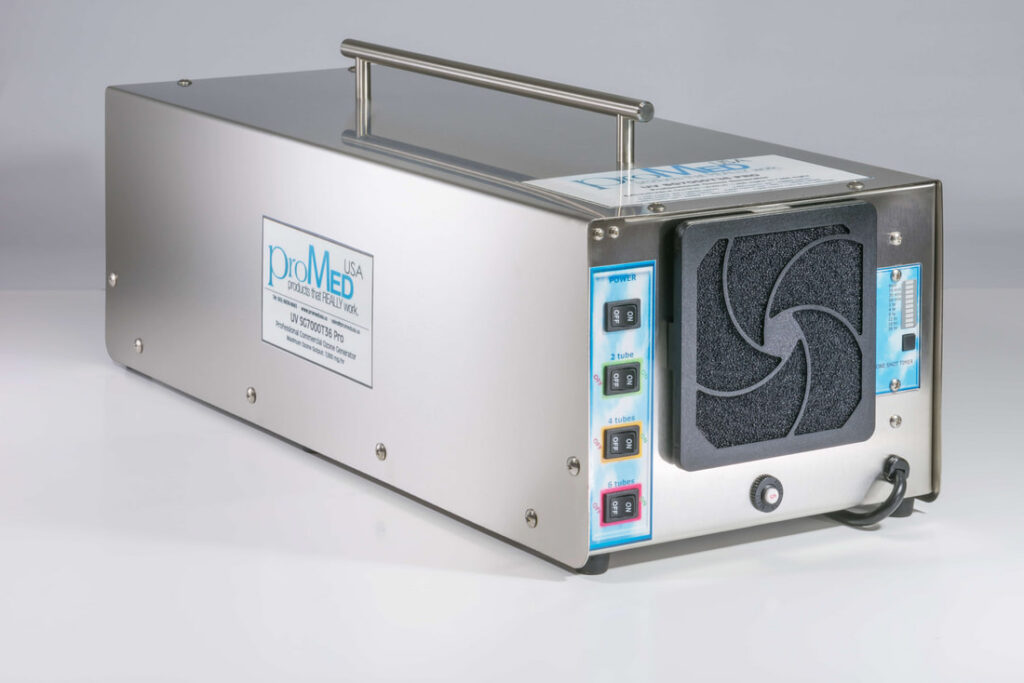
ProMedUSA’s SG Series are purpose-built commercial ozone generators in surgical-grade 316 stainless steel housings. They are not consumer devices or repurposed home air purifiers. Designed in Singapore and exclusively built for us in Canada, they are professional instruments, engineered for the demanding conditions of real Singapore bin centres — high humidity, chemical exposure, daily use.
All four models (SG3000, 4200, 7000, and 15,000) in the SG Series carry a 6-year international warranty. No competing product in the Singapore market offers comparable warranty coverage.
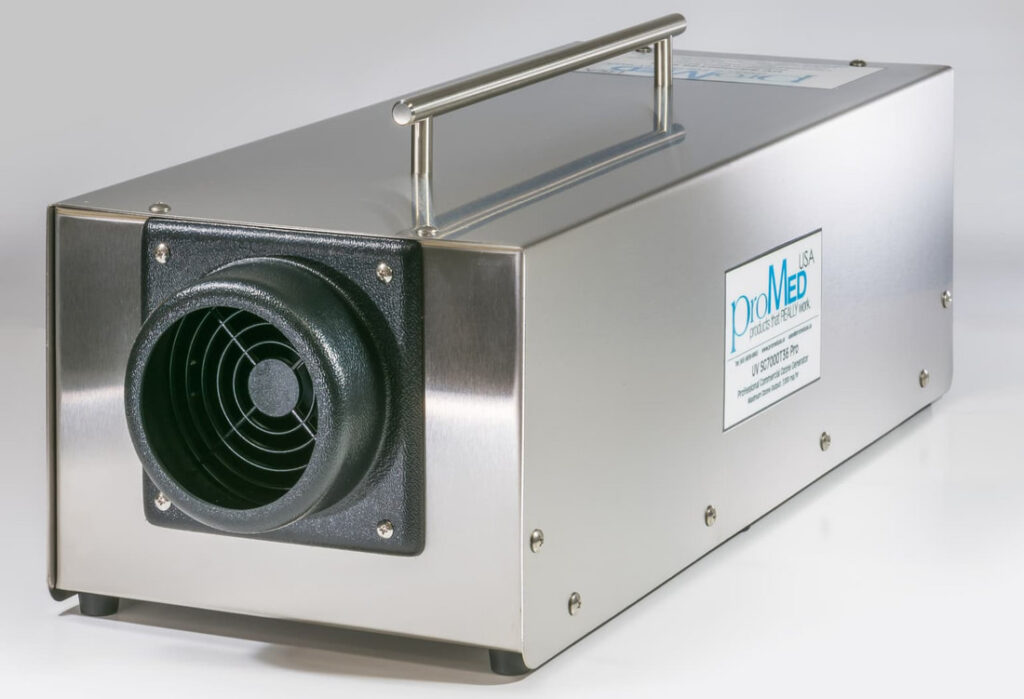
– SG-3000 | 3,000 mg/hr | Smaller bin rooms, individual grease trap rooms, digester rooms | Up to 150 m²
– SG-4200 | 4,200 mg/hr | Mid-size compactor rooms, refuse chambers, larger grease trap areas | Up to 250 m²
– SG-7000 | 7,000 mg/hr | Large hotel and mall bin centres, multi-loading dock areas, heavy commercial waste rooms | Up to 500 m²
– SG-15000 ULTRAMAX | 15,000 mg/hr | Industrial-scale waste facilities, large integrated development bin rooms, waste treatment plants | 500 m² and above
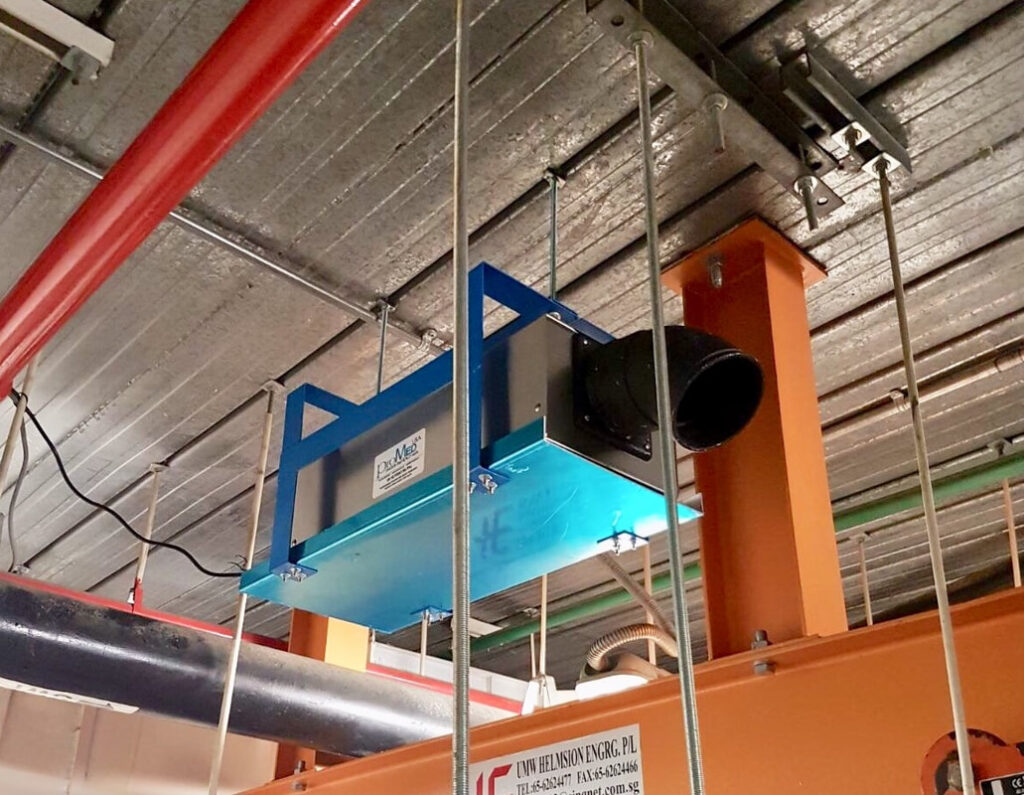
Ceiling-Mounted Installation: Continuous Automated Odour Control
The SG Series generators are fully portable — they can be carried from room to room by a single building engineer with no tools and no installation. For properties that prefer continuous or scheduled automated treatment rather than periodic manual sessions, the SG Series can also be ceiling-mounted and ducted directly into the waste area.
How a Bin Centre Ozone Treatment Works: Four Steps
- Clear and close the bin centre. Remove all personnel. Close doors and seal significant gaps. No need to remove waste — treating with waste present is often more effective.
- Position the SG Series unit. Place it centrally or at one end of the space. Plug into any standard Singapore 13A socket. No tools, no installation.
- Set the controls and walk away. Select the appropriate ozone output level for the space size. Set the one-shot timer for your target treatment duration. The unit runs the cycle and shuts off automatically.
- Ventilate briefly and re-enter. Allow 20 to 30 minutes after the cycle for ozone to revert to oxygen. If you want, open the doors, air the space for a few minutes, and re-enter. The odour is gone — not suppressed, not masked. Eliminated at the molecular level.
The same unit can immediately be moved to the grease trap room, then to the compactor room — all in a single morning shift, with no reinstallation between spaces. This portability is a significant operational advantage over fixed installation odour control systems.
Frequently Asked Questions: Bin Centre Odour Control in Singapore
Q: What causes bin centre odours in Singapore?
Bin centre odours in Singapore are primarily caused by the rapid breakdown of organic waste in high heat and humidity. The main gases produced are hydrogen sulphide (rotten egg smell), ammonia, methane, and various volatile organic compounds (VOCs). Singapore’s climate — typically 31 to 33°C with relative humidity above 80% — accelerates this decomposition significantly compared to cooler climates, meaning odours develop within hours rather than days.
Q: How do ozone generators eliminate bin centre smells?
Ozone generators produce ozone (O₃), a powerful oxidising agent that chemically reacts with and destroys odour-causing molecules including hydrogen sulphide, ammonia, and VOCs. Unlike masking sprays that cover the smell, ozone breaks the chemical bonds of the odour molecule itself. After the reaction, ozone reverts to ordinary oxygen (O₂), leaving no chemical residue. ProMedUSA’s SG Series UV ozone generators deliver controlled ozone concentrations calibrated to the volume and contamination level of the specific space being treated.
Q: Is ozone treatment safe for a Singapore commercial building?
Yes. The Ozone treatment is conducted in unoccupied spaces. The bin centre, compactor room, or grease trap room is closed and cleared of all personnel during treatment. After the treatment cycle ends, ozone naturally reverts to simple, plain oxygen (O2) within about 30 minutes. There is no chemical residue, no hazardous byproduct, and no impact on adjacent occupied spaces when the treatment protocol is followed correctly. If desired ProMedUSA can provide a full written treatment protocol for your building management team.
Q: Are ProMedUSA ozone generators NEA-compliant in Singapore?
Yes. When used as directed, ProMedUSA’s SG Series generators are engineered to operate within ozone concentration parameters that comply with NEA (National Environment Agency) Singapore guidelines.
Q: Do we need to empty the bin centre before ozone treatment?
No. It is not necessary to empty the bin centre before treatment — in fact, treating with waste present is often more effective, because the ozone penetrates the waste mass and embedded surfaces where odour compounds are most concentrated.
Q: How is ozone treatment different from bio-enzyme odour treatment?
Bio-enzyme treatments introduce bacteria or enzymes that slowly break down organic matter over days and weeks. They require repeated applications, take time to show results, and cannot address an acute odour event. In fact, they often create a terrible smell, sometimes worse than the garbage itself!
Ozone treatment works immediately — in one session — by chemically destroying odour molecules throughout the entire volume of the space, including on porous surfaces and in drain channels where bio-enzymes cannot penetrate. Results from ozone treatment are immediate and complete; bio-enzyme results are gradual and require ongoing maintenance.
Q: Can one ProMedUSA ozone generator treat multiple rooms in a single session?
Yes. The SG Series generators are fully portable and require no installation — a single building engineer can carry the unit from room to room, treat the bin centre, move to the grease trap room, then to the compactor room, all in one morning. This makes the SG Series significantly more operationally efficient than fixed installation odour control systems, which are locked to a single location.
Q: Which ProMedUSA ozone generator model is right for a Singapore hotel bin centre?
For a typical Singapore four- or five-star hotel bin centre, the SG-7000 is usually the recommended model — it produces 7,000 mg/hr of ozone and covers spaces up to 500 m², which encompasses most hotel bin centre and compactor room configurations. For smaller hotels or individual grease trap rooms, the SG-3000 or SG-4200 may be more appropriate. For large integrated resort or shopping mall facilities, the SG-15000 UltraMax is specified. ProMedUSA offers free on-site assessments to confirm the correct model for your property.
Q: What is the warranty on ProMedUSA SG Series ozone generators?
All ProMedUSA SG Series ozone generators carry a 6-year international warranty — significantly longer than any comparable prodQ: Can ProMedUSA ozone generators be permanently installed in a bin centre?uct currently available in the Singapore market. This reflects the commercial-grade build quality of the 316 stainless steel housing and professional UV ozone generation components.
Q: Can ProMedUSA ozone generators be permanently installed in a bin centre?
Yes. While the SG Series units are designed to be portable for flexible deployment across multiple rooms, they can also be ceiling-mounted and connected to ducting for continuous or timer-controlled automated operation within a fixed space. This installation approach is almost always used in Singapore bin centres and compactor rooms where ongoing automated odour suppression is preferred over periodic manual treatment sessions.
We offer professional installation upon request.