


More hotels today are beginning to invest in IAQ monitoring and hotel indoor air quality assessments inside guest rooms, corridors, lobbies, and HVAC systems.
Sometimes the process starts because of guest complaints. Other times, it comes from online reviews mentioning:
- Musty smells
- Smoke odours
- Damp room conditions
- Stale air
- Renovation fumes
- Chemical smells
- Poor room freshness
Once indoor air quality testing confirms elevated VOCs or odour problems, hotel operators usually ask the next question: “Now that we know the IAQ is poor, how do we actually remove these odours and VOC smells from the room?”
For many hotels in Singapore and throughout Southeast Asia, the answer increasingly involves portable bipolar ionizer technology designed specifically for hospitality air purification and guest room deodorization.
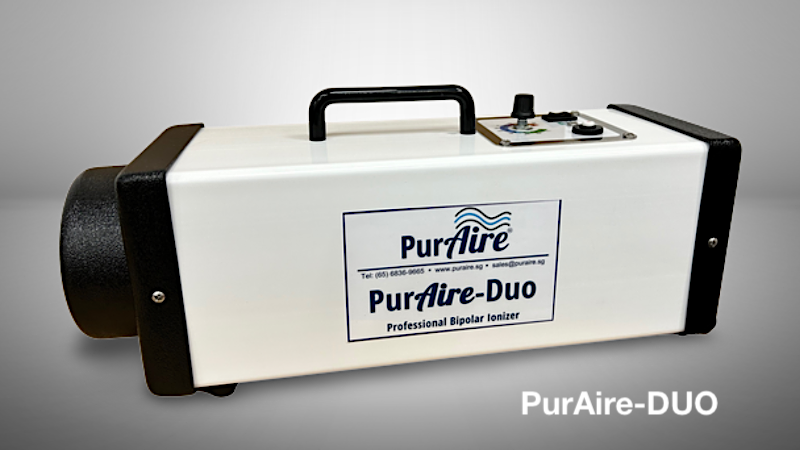
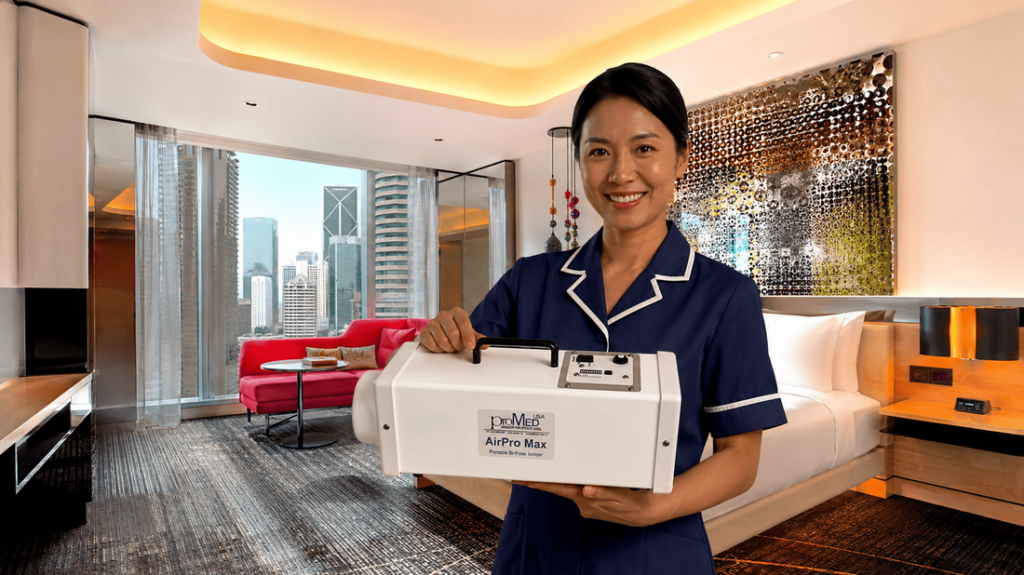
Today, many hotel engineering teams and housekeeping departments are using the ProMedUSA AirPro-MAX and the PurAire PurAire-DUO portable bipolar ionizers to help improve indoor air quality, support VOC reduction, and provide faster airborne odour neutralization between guest stays.
Why Hotel Rooms Develop Persistent Odours:
Hotel rooms experience constant occupant turnover, making hotel room odour control an ongoing operational challenge. Common sources of indoor air contaminants inside hotels include:
- Cigarette and cigar smoke
- Vape residue
- Renovation VOCs
- Furniture off-gassing
- Humidity and condensation
- Mould and mildew
- Damp carpets and curtains
- Bathroom moisture
- Cleaning chemicals
- Food odours
- Perfumes and fragrances
- HVAC-related smells
In tropical Southeast Asian climates such as Singapore, Malaysia, Thailand, and Indonesia, humidity often worsens these problems because moisture allows odours to become trapped inside fabrics, soft furnishings, FCUs, carpets, and wall materials. Even after cleaning, many rooms may continue to develop:
- Musty smells
- Damp odours
- Stale room air
- Smoke residue smells
- Persistent VOC smells
This is one reason why many hotels are now investing more heavily in hospitality air purification and IAQ solutions for hotels rather than relying only on traditional cleaning methods.
Why Hotels Are Moving Away From Heavy Fragrances:
For many years, hotels attempted to solve guest room odour problems using strong perfumes, aerosol sprays, and fragranced cleaning products. Often these were marketed as “Signature Scents”.
Today, however, many hospitality operators are rethinking this strategy because guests (especially children) are becoming increasingly sensitive to artificial fragrances and airborne chemical exposure.
One concern is that many commercial fragrance formulations contain proprietary chemical blends that are not always fully disclosed to building operators or housekeeping departments. This creates transparency challenges for hotels attempting to improve hotel indoor air quality while also managing guest wellness expectations responsibly.
Many fragranced products may release volatile organic compounds (VOCs) into indoor environments, including:
- Terpenes
- Solvents
- Aldehydes
- Synthetic musks
- Phthalates
- Other fragrance-related airborne chemicals
Scientific literature has reported associations between certain fragrance-related compounds and:
- Respiratory irritation
- Headaches
- Eye and throat irritation
- Asthma triggering in sensitive individuals and children
- Chemical sensitivity reactions
- Indoor air quality complaints
Some studies have also explored possible carcinogenic concerns associated with prolonged exposure to certain airborne chemical compounds under specific conditions. At the same time, it is important to distinguish between correlation and confirmed causation. Actual health risk depends on factors such as:
- Concentration levels
- Exposure duration
- Ventilation quality
- Occupant sensitivity
- HVAC airflow
- The specific compounds involved
For most hotels, the issue is less about creating alarm and more about reducing unnecessary indoor air contaminants while improving guest comfort and wellness perception. As a result, many hotels are shifting away from heavy fragrance masking and toward cleaner air strategies focused on:
- Airborne odour neutralization
- VOC reduction
- Hotel indoor air quality improvement
- Low-chemical guest room deodorization
- Hospitality air purification technologies
This shift is one reason why ozone-free bipolar ionization systems like the ProMedUSA AirPro-MAX and the PurAire Singapore model PurAire-DUO are becoming increasingly popular in hospitality environments.
The ProMedUSA AirPro-MAX Portable Bipolar Ioniser:
The AirPro-MAX is a portable hotel ionizer designed specifically for rapid guest room deodorization, hospitality air purification, and hotel odour removal Singapore applications.
The AirPro-MAX portable bipolar ionizer continuously distributes positive and negative Oxygen ions into the room to support:
- VOC reduction
- Airborne odour neutralization
- Mould odour control
- Smoke odour reduction
- Indoor air contaminant reduction
- Improved perceived room freshness
Hotels often use the AirPro-MAX for:
- Smoker rooms
- Damp room conditions
- Post-renovation guest rooms
- Musty FCU odours
- Stale guest room air
- Rapid room turnover preparation
One reason the AirPro-MAX has become popular with housekeeping teams is because it supports operational efficiency. The unit is:
- Lightweight (1.2KG)
- Portable
- Easy to move room-to-room
- Simple to operate
- Suitable and safe for continuous occupied room hospitality use
Unlike bulky filtration systems, the AirPro-MAX provides filterless air purification without requiring complicated installation or maintenance procedures. It’s easy to use, freshens a room in just a few minutes and is built to withstand harsh and heavy usage.
The PurAire DUO Portable Bipolar Ioniser:
The PurAire-DUO is another portable bipolar ionizer commonly used for hotel indoor air quality improvement and commercial bipolar ionization applications throughout Southeast Asia.
Like the AirPro-MAX, the PurAire DUO is designed to support:
- VOC reduction
- Airborne odour neutralization
- Guest room deodorization
- Mould odour control
- Smoke odour reduction
- Hospitality air purification
Hotels often choose the PurAire DUO because it provides:
- Quiet operation
- Portable deployment
- Low maintenance
- Filterless air purification
- Continuous operation capability
PurAire Singapore solutions are commonly used in:
- Hotels
- Resorts
- Serviced apartments
- Commercial buildings
- Healthcare environments
Many facility managers and professional housekeepers prefer portable hotel ionizer systems because they can be deployed quickly during housekeeping operations without major HVAC modifications.
Why Portable Bipolar Ionisers Work Well in Hospitality:
Hotels need IAQ solutions that work within real-world operational conditions. That means:
- Fast room turnover
- Minimal downtime
- Easy housekeeping deployment
- Quiet operation
- Portable flexibility
- Low maintenance requirements
- Minimal disruption to guests
Portable bipolar ionizer systems fit naturally into housekeeping workflows because they can simply be moved from room to room during cleaning operations. This is why over 900 professional housekeepers and facility managers rely every day on the AirPro-MAX and PurAire-DUO
Unlike heavy fragrance systems that attempt to mask smells, commercial bipolar ionization systems are designed to support airborne odour neutralization and improved indoor air quality without introducing strong perfumes into occupied spaces.
For hospitality operators focused on ESG initiatives, guest wellness, and hotel indoor air quality, this approach aligns more closely with modern IAQ management strategies.
Hotel HVAC Purification & IAQ Monitoring:
Many hotels are also beginning to integrate portable IAQ strategies with larger hotel HVAC purification programs. As IAQ monitoring becomes more common in the hospitality industry, hotels are paying closer attention to:
- VOC levels
- Humidity
- Airborne particles
- Guest comfort
- Mould risks
- Odour complaints
- Indoor air contaminants
This growing focus on measurable IAQ performance is driving increased interest in hospitality air purification technologies that can support:
- Better guest experiences
- Improved room freshness
- Reduced odour complaints
- Healthier indoor environments
Why IAQ Matters More Than Ever in Hospitality:
Today’s hotel guests are more aware of indoor air quality than ever before. A room may appear visually clean, but if it smells:
- musty
- smoky
- damp
- stale
- chemical-heavy
the guest experience is immediately affected. Online reviews mentioning poor air quality, mould smells, or stale guest rooms can directly impact hotel reputation and occupancy. Room change requests are expensive and often reported in social media. Smelly rooms need to be taken out of inventory and this directly affects the properties ROI and bottom line.
This is why many hotels are now treating hotel indoor air quality as part of the overall guest experience — not simply a housekeeping issue.
Final Thoughts:
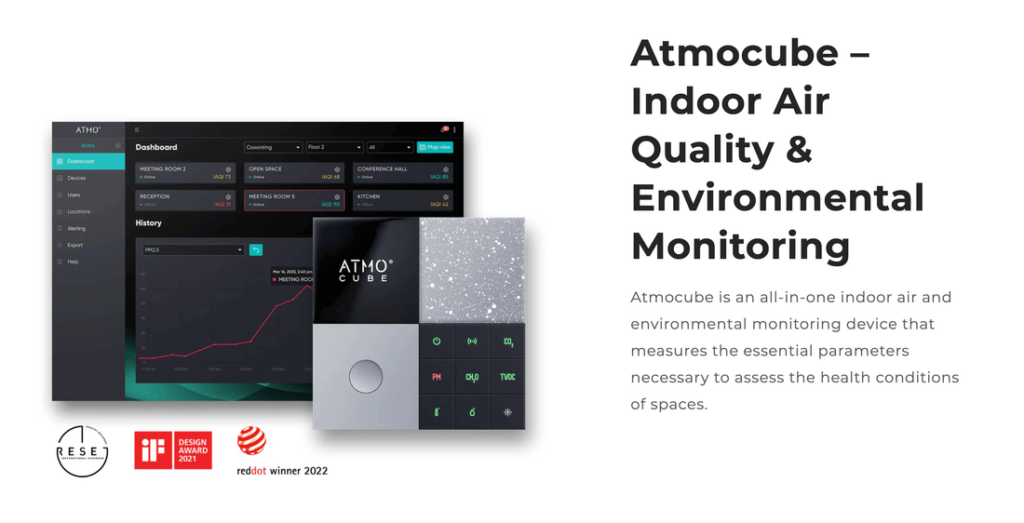
Measuring IAQ is only the first step. Our Atmocube professional (yet affordable) IAQ Monitor and Sensor is the first step in identifying the problems.
Once odours, VOCs, or indoor air contaminant problems are identified, hotels need practical solutions that fit real operational workflows. For over 900 hospitality operators in Singapore and Southeast Asia, portable bipolar ionizer systems like the ProMedUSA AirPro-MAX and the PurAire-DUO are becoming preferred solutions for:
- Hotel room odour control
- Guest room deodorization
- VOC reduction
- Mould odour control
- Hospitality air purification
- Airborne odour neutralization
- Hotel indoor air quality improvement
Their portability, ease of use, and compatibility with daily housekeeping operations make them practical IAQ solutions for hotels focused on guest comfort, operational efficiency, and healthier indoor environments.
Frequently Asked Questions:
Q. Can bipolar ionization help remove VOC smells from hotel rooms?
Portable bipolar ionization systems are commonly used to support VOC reduction and airborne odour neutralization in hotel guest rooms, particularly after smoking, renovation work, or persistent musty odours.
Q. Why do hotel rooms still smell musty after cleaning?
Odours often remain trapped inside carpets, curtains, upholstery, FCUs, and soft furnishings, especially in humid climates like Singapore and Southeast Asia.
Q. Are artificial fragrances bad for hotel indoor air quality?
Some fragrance products may release VOCs and other airborne compounds that can contribute to indoor air quality complaints or respiratory irritation in sensitive individuals.
Q. What is a portable hotel ionizer?
A portable hotel ionizer is a movable air treatment device designed to support indoor air quality improvement and odour reduction inside hospitality environments.
Q. What causes VOC smells in hotel rooms?
Common sources include renovation materials, cleaning chemicals, smoke residue, furniture off-gassing, mould, and poor ventilation.
Q. What is the difference between ozone and ozone-free bipolar ionization?
Ozone systems generate ozone gas for oxidation, while ozone-free bipolar ionization systems are designed to provide airborne contaminant reduction and odour neutralization without intentionally producing ozone above certified limits.
Need Help Improving Hotel Indoor Air Quality?
ProMedUSA Singapore provides IAQ solutions for hotels, resorts, healthcare facilities, serviced apartments, and commercial buildings throughout Southeast Asia.
To learn more about:
- AirPro-MAX Singapore
- PurAire Singapore
- Portable bipolar ionizer systems
- Hotel odour removal Singapore
- Hospitality air purification
- IAQ monitoring solutions
Visit: www.promedusa.us and www.puraire.sg