


After 20 years and more than 1,000 client organisations across Singapore and Southeast Asia, ProMedUSA explains why active Glass DBD bipolar ionisation outperforms passive HEPA filtration for commercial spaces — and when each technology has its proper place.
Twenty years ago, when ProMedUSA started deploying air quality solutions in Singapore’s hotels, hospitals, and commercial facilities, the conversation was mostly about filtration. HEPA was the gold standard. If you had a HEPA unit in the room, you had air purification covered.
What two decades of measured outcomes taught us — using calibrated instruments, not intuition — is that the type of purification matters as much as the specification. And the type that consistently outperforms in Singapore’s sealed, air-conditioned commercial environment is active, not passive.
Passive purification waits for pollutants to come to the machine. Active Glass DBD bipolar ionisation goes to the pollutants — throughout the entire space, including every surface — and it does so safely, continuously, and without ozone.
The Fundamental Limitation of Passive Filtration
A HEPA filter is a physical barrier. Air passes through it. Particles get trapped. It’s reliable and well-understood.
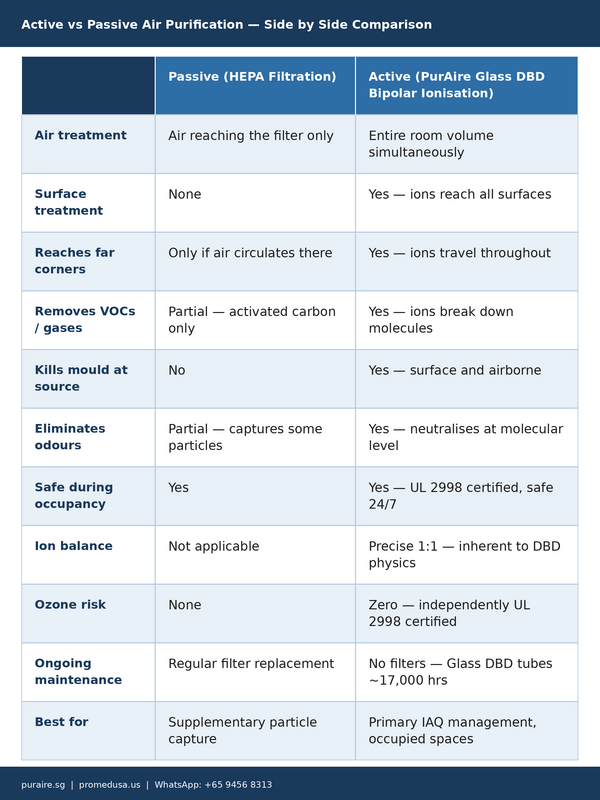
The problem is the word ‘passes.’ The filter only treats air that reaches it. In Singapore’s large, sealed, air-conditioned commercial spaces:
• Air in far corners may take hours to circulate past the filter — if it ever does
• Surfaces — walls, curtains, carpets, aircon vents — are completely unaffected
• VOCs pass through HEPA media almost entirely unimpeded
• Mould growing inside an aircon duct gets distributed throughout the room — the HEPA unit captures some spores but doesn’t address the source
• Hotel rooms turning over in 25 minutes don’t give a HEPA unit enough time to process the entire room volume
These aren’t flaws in HEPA as a technology. They’re the physics of how passive filtration works. The machine can only clean what comes to it.
Why Glass DBD Bipolar Ionisation Works Differently — and Why the Design Matters
PurAire Glass DBD Cold Plasma bipolar ionisation generates positive and negative oxygen ions continuously and releases them into the entire room — not waiting for air to come to the unit.
The physics of why this works — and why it’s safe — is worth understanding.
Not All Bipolar Ionisation Is the Same — Why the Technology Design Matters
This is where most articles miss the point entirely. ‘Bipolar ionisation’ is not a single technology. It’s a category — and the design underneath it makes all the difference.
How Glass DBD Cold Plasma Works
DBD stands for Dielectric Barrier Discharge. In PurAire’s Glass DBD systems, an alternating current (AC) voltage is applied across two electrodes separated by a glass dielectric barrier. That barrier acts like a capacitor — it caps the current and prevents harsh electrical arcs. Instead, it creates millions of evenly distributed micro-discharges across the surface.
As the AC cycle alternates between positive and negative voltages, air molecules passing through the plasma field simultaneously gain and lose electrons — producing a naturally balanced 1:1 ratio of positive and negative oxygen ions. No engineering tricks required. It’s inherent to the physics of how DBD works.
Because the discharge is distributed evenly — not concentrated at a single point — there are no localised high-energy hotspots. That’s the reason Glass DBD produces virtually no ozone. The thermal conditions that would split O2 molecules into atomic oxygen simply don’t occur.
How Corona Discharge Ionisation Works — and Why It’s Different
Corona discharge uses a high-voltage current applied to a sharp conductive tip — a needle, carbon fibre emitter, or tungsten point. The concentrated electrical field around that tip creates a localised plasma plume.
Here’s the critical problem: if the system uses direct current (DC), it produces only one polarity of ions — positive or negative, not both. That’s not true bipolar ionisation at all. To produce genuine bipolar output from corona discharge, manufacturers must either use AC on a single needle or pair separate positive and negative needle arrays — a specific engineering choice that many cheaper units simply don’t make.
More importantly, the intense localised energy at a corona needle tip creates the high-temperature conditions that split O2 molecules — generating ozone as a byproduct. As needle tips age, oxidise, and accumulate deposits, voltage regulation becomes inconsistent and ozone output can spike unpredictably.
Glass DBD is inherently bipolar, inherently low-ozone, and inherently stable. Corona discharge can be engineered to approach that standard — but it requires specific design choices, and many commercial units don’t make them. UL 2998 certification is the independent proof of which category a product actually falls into.
What 8 Years of Singapore Deployments Shows
ProMedUSA added certified PurAire Glass DBD bipolar ionisation to our portfolio in 2017 — after the technology and UL 2998 independent certification met our standards for recommendation. Since then, we’ve measured real-world outcomes using calibrated instruments:
• Mould counts reduced measurably in hotels and clinics within weeks of installation
• VOC levels in newly renovated spaces drop significantly within days
• Persistent odours — cigarette smoke, cooking, mildew — eliminated at source, not masked
• Guest satisfaction scores improve when bipolar ionisation is part of the room package
These outcomes are measured with the Atmocube IAQ monitor — tracking 12 parameters including CO2, PM2.5, VOCs, temperature, and humidity — and the Aeroqual S500 ozone sensor to NEA and EPA standards. Field results in actual Singapore properties, not laboratory conditions.
Science and certification together confirm the technology and our products are safe and beneficial. Eight years of Singapore field results back that up.
Active vs Passive: Direct Comparison
ProMedUSA’s IAQ Evolution — 20 Years, Three Technologies
ProMedUSA has been Singapore’s trusted IAQ provider since 2006. That history breaks down clearly:
- 2006 — Professional UV ozone generators for deep odour removal and surface disinfection in unoccupied commercial spaces
- 2010 — Expanded into air purification solutions for occupied spaces
- 2017 — Added certified PurAire Glass DBD bipolar ionisation after the technology and UL 2998 independent certification met our standards for recommendation
Eight years of bipolar ionisation deployments. Twenty years of IAQ expertise. We added bipolar ionisation to our portfolio because the science was solid, the certification was independent, and the results were measurable — not because it was fashionable.
When Each Technology Is the Right Choice
After 20 years and more than 1,000 client organisations across Singapore and Southeast Asia, our honest position:
- HEPA filtration: excellent supplementary particle capture, effective in small well-ventilated spaces, appropriate alongside active systems for comprehensive coverage
- PurAire Glass DBD bipolar ionisation (fixed, wall-mounted, in-duct): primary IAQ management for occupied commercial spaces — hotels, clinics, offices, facilities — where 24/7 active treatment of air and surfaces is the requirement
- ProMedUSA UV ozone generators: deep treatment of unoccupied spaces — vacant hotel rooms, bin centres, garbage rooms, vehicles — where high-concentration ozone eliminates heavy odours and disinfects surfaces before re-occupancy
The right technology matched to the actual problem. That’s the approach that produces results you can measure rather than specifications that look impressive on paper.
Frequently Asked Questions
Q. Why doesn’t a HEPA air purifier clean the whole room?
Because it only treats air that physically passes through its filter. Air in corners, near ceilings, behind furniture, and on surfaces doesn’t necessarily reach the filter — particularly in Singapore’s large, sealed, air-conditioned commercial spaces. Active Glass DBD bipolar ionisation sends ions to the pollutants rather than waiting for them to arrive
Q. How does ProMedUSA measure real-world air quality improvement?
We use calibrated instruments including the Atmocube IAQ monitor — measuring 12 critical parameters including CO2, PM2.5, VOCs, temperature, and humidity — and the Aeroqual S500 ozone sensor meeting NEA and EPA standards. Pre and post-installation measurement is available on request for clients who want documented evidence of air quality improvement.
Q. Why is Glass DBD bipolar ionisation safer than corona discharge designs?
Glass DBD distributes the electrical discharge evenly across a dielectric surface — no localised high-energy hotspots, so no ozone-generating conditions. Corona discharge concentrates energy at a needle tip, creating thermal conditions that split O2 molecules into ozone, especially as tips degrade. Glass DBD is inherently safer by design, and UL 2998 certification independently verifies the zero-ozone result.
Q. Is active bipolar ionisation better than passive HEPA for Singapore hotels?
For primary IAQ management in Singapore’s sealed, air-conditioned hotel environment — yes. HEPA cannot treat surfaces, cannot reach areas without air circulation, and cannot keep pace with rapid room turnovers. PurAire Glass DBD active bipolar ionisation treats the entire room including surfaces from the moment it’s running, achieving measurable improvement within minutes.
Q. How long has ProMedUSA been in the Singapore IAQ industry?
Since 2006 — 20 years across three complementary technologies. UV ozone generators from 2006, air purification solutions from 2010, and certified PurAire Glass DBD bipolar ionisation from 2017.
Trusted by more than 1,000 hotels, resorts, hospitals, government facilities, and commercial organisations across Singapore, Southeast Asia and the Middle East.
The Bottom Line
Passive filtration does what it says. It filters the air that comes to it.
Active Glass DBD bipolar ionisation does something different: it goes to the air, and to every surface in the space. In Singapore’s commercial and hospitality environment, that difference is measurable. We’ve been measuring it since 2017.
Talk to us about active IAQ for your property. WhatsApp James: